
ADLS Gen2 and Azure Blobs SAS Key Connectivity

ou can now connect to Azure Data Lake Storage Gen 2 or Azure Blob Storage using Share Access Signature (SAS) Keys! This option will replace the need to connect through the Web Connector, which can leave your SAS key exposed. This feature will come to PowerBI Desktop in August.

To connect to ADLS Gen2 or Azure Blobs using SAS Keys:

  1. Navigate to powerbi.com.
  2. In your workspace, create a new Dataflow or Dataset.
  3. On the “Choose data source” page, search for your data source (ie. “Azure Data Lake Storage Gen 2” or “Azure Blobs”) and select a source.


    Step 3) Search for and select your data source
  4. In the Authentication kind drop down, select the Shared Access Signature (SAS) option. To retrieve your SAS token, go to portal.azure.com, navigate to your resource, and, under Security + networking, select shared access signature and scroll down to view the SAS token. Paste the value into the box and select next.
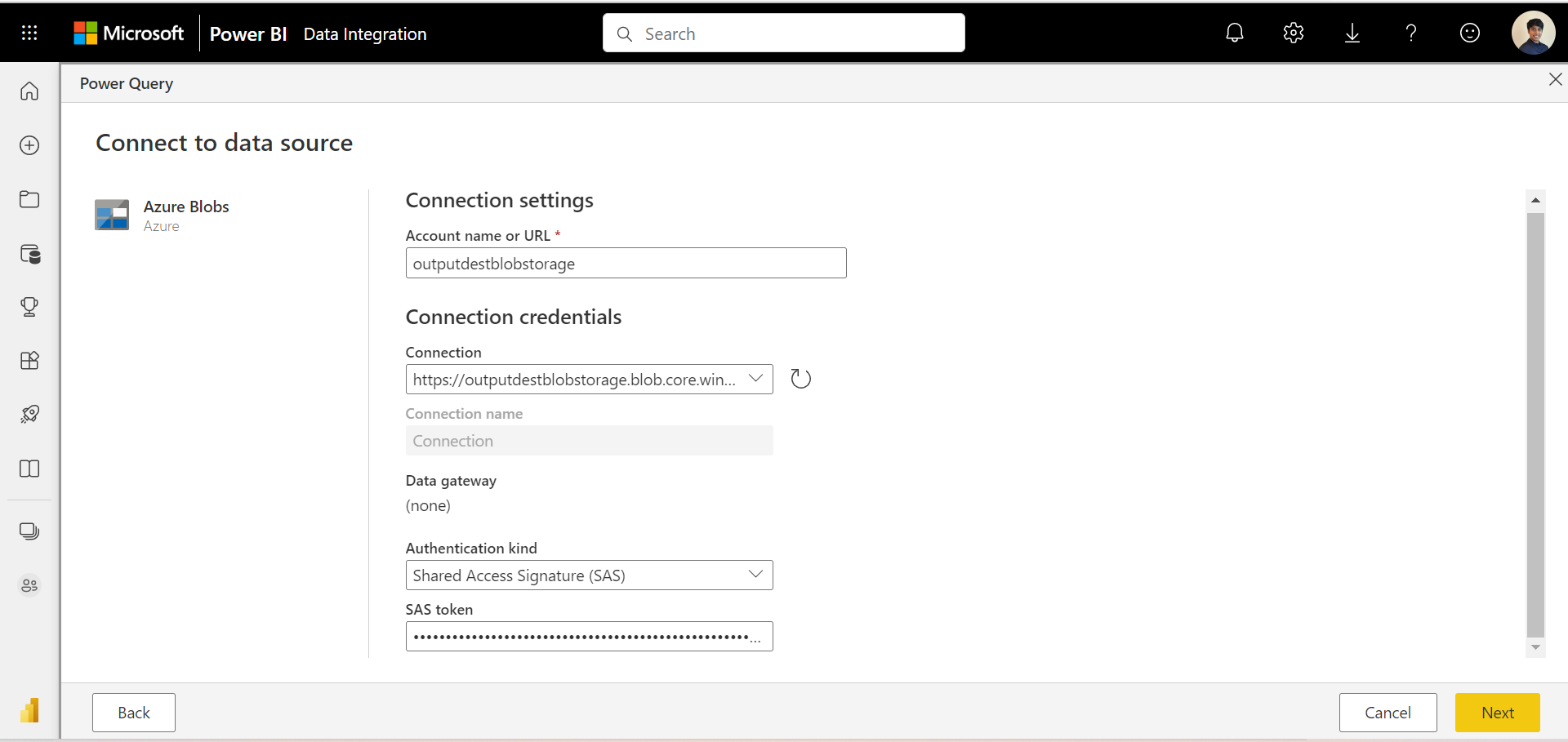


    Step 4) Select “Shared Access Signature (SAS)” from the Authentication kind drop down and paste the SAS token for the data source
  5. Proceed with the rest of the data transformation as usual!

Comments

Post a Comment

Hi User,
Thanks for visiting My Blog and please provide your valuable feedback and subscribe for more updates. Please don't post any spam content or comments.
Thank You

Popular posts from this blog

SSRS INTERVIEW QUESTIONS

Q: What is SSRS? Ø   SSRS or SQL Server Reporting Service is a server-based report generation software systems from Microsoft and is part of Microsoft BI. Ø   It is used for preparing and delivering interactive and variety of reports. Ø   It is administered through an web based interface. Ø   Reporting services utilizes a web service interface for supporting and developing of customized reporting applications. Ø   SSRS lets you create very rich reports (Tabular/Graphical/Interactive) from various datasources with rich data visualization (Charts, Maps, sparklines) Ø   SSRS allows are reports to be exported in various formats (Excel, PDF, word etc) Q: Explain SSRS Architecture? Reporting services architecture comprises of integrated components. It is a multi-tiered, included with application, server and data layers. This architecture is scalable and modular. A single installation can be used across multiple computers. It includes the fo...

Exception deserializing the package "The process cannot access the file because it is being used by another process."

TITLE: Microsoft Visual Studio ------------------------------ Failed to start project ------------------------------ ADDITIONAL INFORMATION: Exception deserializing the package "The process cannot access the file 'E:\SSASCube\HistoricalDataLoad\HistoricalDataLoad\bin\Development\HistoricalDataLoad.ispac' because it is being used by another process.". (Microsoft.DataTransformationServices.VsIntegration) ------------------------------ The process cannot access the file 'E:\SSASCube\HistoricalDataLoad\HistoricalDataLoad\bin\Development\HistoricalDataLoad.ispac' because it is being used by another process. (mscorlib) ------------------------------ BUTTONS: OK ------------------------------ While running SSIS package i got the error “The process cannot access the file ‘*.ispac’ because it is being used by another process”. I tried to close SSDT and run it again but, I still got the same error while compiling. Then, after searching over internet, I got...

Failed to execute the package or element. Build errors were encountered

Error: TITLE: Microsoft Visual Studio ------------------------------ Failed to execute the package or element.   Build errors were encountered. For more information, see the Output window. ------------------------------ BUTTONS: OK ------------------------------   Solution: We tried to close SSDT and run it again but, we still got the same error while running SSIS package. Then, we need to follow bellow solution: Step 1: Go to Task Manager–> Details Tab. Step 2: Locate the process “ DtsDebugHost.exe “. Kill this process. There might be multiple instances of this process. Kill all of them. Step 3: Rerun SSIS package