New cache refresh settings available in Power BI Premium
Earlier this year, we announced the additional Analysis Services server properties that are now supported in Power BI Premium and Power BI Embedded. With this capability, Power BI administrators can modify XMLA-based Analysis Services server properties to optimize, govern, and alter query behavior in their workspaces. Today, we are adding another familiar server property that will be supported in Power BI! We are happy to announce that ClientCacheRefreshPolicy is now a configurable property for your Power BI Premium workspaces. Admins can override scheduled cache refresh settings for an entire workspace, improving the performance of their semantic models.
The default behavior in the Power BI service is to automatically cache dashboard, tile, and report queries upon refresh to provide an optimal report viewing experience. For enterprise semantic model deployments, where hundreds of reports and artifacts are built from a single Power BI dataset, automatic caches may cause performance issues. For example, queuing a high number of queries after every refresh, results in longer refresh times as well as unnecessary loads on the dataset. With the ClientCacheRefreshPolicy property, admins can disable the automatic cache refresh setting to optimize the behavior of their Power BI datasets.
Note that datasets with refresh operations performed by the XMLA endpoint or the enhanced refresh Power BI REST API, do not automatically refresh tile caches. The ClientCacheRefreshPolicy only applies to datasets with refresh operations performed by the Power BI service (e.g., scheduled or on-demand refreshes). Check out Server properties in Analysis Services for more details on ClientCacheRefreshPolicy and other server properties available for Power BI Premium.
How do I enable or disable ClientCacheRefreshPolicy for my workspace?
You can enable XMLA-based Analysis Services server properties in your workspace by turning on the toggle to Observe XMLA-based workspace settings. To enable navigate to datasets workload in the Capacity Settings page under Admin Portal.

How do I modify a ClientCacheRefreshPolicy for a workspace?
- Follow these steps to get your workspace connection URL
- Open SQL Server Management Studio (SSMS)
- Connect to your Premium workspace in SSMS
- In Object Explorer, right click on the Premium workspace and select Properties

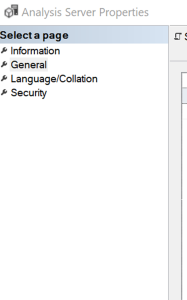
- In the Analysis Services Properties panel select General

- Check the Show Advanced (All) Properties box

- Modify the Value column. The default value for this property is -1, which allows all background cache refreshes for the dataset. To discourage all background cache refreshes, specify zero (0)
- Select OK


Comments
Post a Comment
Hi User,
Thanks for visiting My Blog and please provide your valuable feedback and subscribe for more updates. Please don't post any spam content or comments.
Thank You