
Keyboard shortcuts in Power BI Desktop

 You can press Shift + ? to show keyboard shortcuts, as shown in the following image.
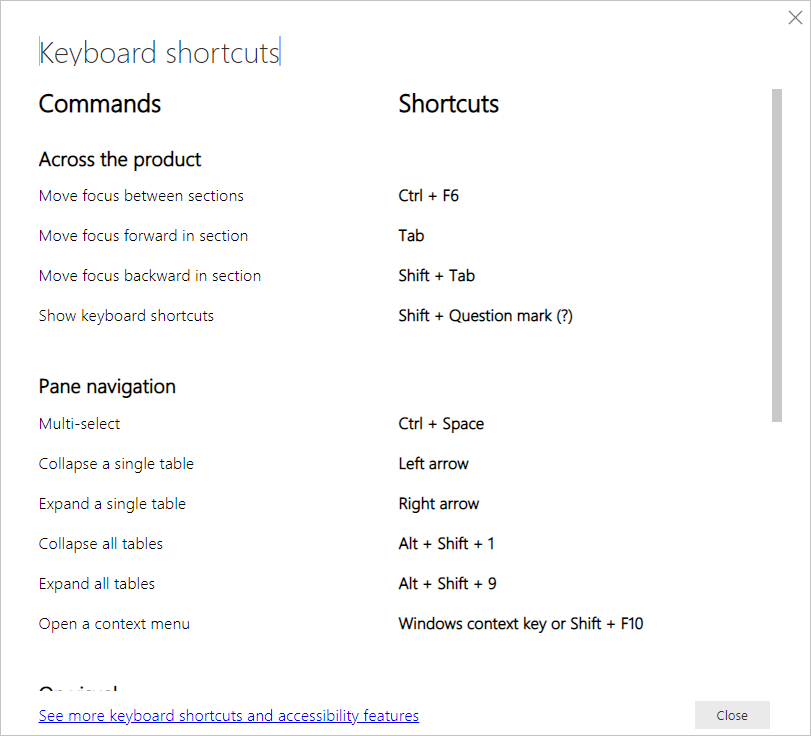
Press Shift + ? in Power BI Desktop to show accessibility keyboard shortcuts

In addition to using these keyboard shortcuts in Power BI Desktop, these shortcuts work in the following experiences as well:

  • Q&A Explorer dialog
  • Getting Started dialog
  • File menu and About dialog
  • Warning bar
  • File Restore dialog
  • Frowns dialog

In our continued effort to improve accessibility, the previous list of experiences also support screen readers and high contrast settings.

Frequently used shortcuts

FREQUENTLY USED SHORTCUTS
To do this actionPress
Move focus between sectionsCtrl + F6
Move focus forward in sectionTab
Move focus backward in sectionShift + Tab
Select or clear selection of an objectEnter or spacebar
Multi-select objectsCtrl + spacebar

On visual

ON VISUAL
To do this actionPress
Move focus to visual menuAlt + Shift + F10
Show dataAlt + Shift + F11
Enter a visualCtrl + Right arrow
Enter a layerEnter
Exit a layer or visualEsc
Select or clear selection of a data pointEnter or spacebar
Multi-selectCtrl + Enter or Ctrl + spacebar
Right-click
  • Windows keyboard: Windows context key + F10. The Windows context key is between the Left Alt key and the Left Arrow Key
  • Other keyboard: Shift + F10
Clear selectionCtrl + Shift + C
Show or hide tooltipCtrl + H

Table and matrix navigation

TABLE AND MATRIX NAVIGATION
To do this actionPress
Move focus up / down one cell (across all cells in all areas)Up arrow key / Down arrow key
Move focus left / right one cell (across all cells in all areas)Left arrow key / Right arrow key

Pane navigation

PANE NAVIGATION
To do this actionPress
Multi-selectCtrl + spacebar
Collapse a single tableLeft arrow key
Expand a single tableRight arrow key
Collapse all tablesAlt + Shift + 1
Expand all tablesAlt + Shift + 9
Open a context menu
  • Windows keyboard: Windows context key + F10. The Windows context key is between the Left Alt key and the Left Arrow Key
  • Other keyboard: Shift + F10

Slicer

SLICER
To do this actionPress
Interact with a slicerCtrl + Right arrow key

Selection pane

SELECTION PANE
To do this actionPress
Activate selection paneF6
Move an object up in the layeringCtrl + Shift + F
Move an object down in the layeringCtrl + Shift + B
Hide / show (toggle) an objectCtrl + Shift + S

DAX editor

DAX EDITOR
To do this actionPress
Go to line numberCtrl + G
Move line up / downAlt + Up arrow key / Down arrow key
Copy line up / downShift + Alt + Up arrow key / Down arrow key
Insert line belowShift + Enter
Insert line aboveCtrl + Shift + Enter
Delete selected wordCtrl + Del
Delete all selected linesCtrl + Shift + K
Jump to matching bracketCtrl + Shift + \
Indent line / Extend line into the marginCtrl + ] / [
Insert cursorAlt + Click
Select current lineCtrl + I
Select all occurrences of current selectionCtrl + Shift + L
Select all occurrences of current wordCtrl + F2
Select next occurrences of current selectionCtrl + D
Enter multiple lines of code up / downCtrl + Alt + Up arrow key / Down arrow key
Comment a lineCtrl + / or Ctrl + K + C
Uncomment a lineCtrl + / or Ctrl + K + U
Increase font sizeCtrl + + Or Scroll Up
Decrease font sizeCtrl + - Or Scroll Down

Enter data

ENTER DATA
To do this actionPress
Exit editable gridCtrl + Tab

Comments

Popular posts from this blog

SSRS INTERVIEW QUESTIONS

Q: What is SSRS? Ø   SSRS or SQL Server Reporting Service is a server-based report generation software systems from Microsoft and is part of Microsoft BI. Ø   It is used for preparing and delivering interactive and variety of reports. Ø   It is administered through an web based interface. Ø   Reporting services utilizes a web service interface for supporting and developing of customized reporting applications. Ø   SSRS lets you create very rich reports (Tabular/Graphical/Interactive) from various datasources with rich data visualization (Charts, Maps, sparklines) Ø   SSRS allows are reports to be exported in various formats (Excel, PDF, word etc) Q: Explain SSRS Architecture? Reporting services architecture comprises of integrated components. It is a multi-tiered, included with application, server and data layers. This architecture is scalable and modular. A single installation can be used across multiple computers. It includes the fo...

Exception deserializing the package "The process cannot access the file because it is being used by another process."

TITLE: Microsoft Visual Studio ------------------------------ Failed to start project ------------------------------ ADDITIONAL INFORMATION: Exception deserializing the package "The process cannot access the file 'E:\SSASCube\HistoricalDataLoad\HistoricalDataLoad\bin\Development\HistoricalDataLoad.ispac' because it is being used by another process.". (Microsoft.DataTransformationServices.VsIntegration) ------------------------------ The process cannot access the file 'E:\SSASCube\HistoricalDataLoad\HistoricalDataLoad\bin\Development\HistoricalDataLoad.ispac' because it is being used by another process. (mscorlib) ------------------------------ BUTTONS: OK ------------------------------ While running SSIS package i got the error “The process cannot access the file ‘*.ispac’ because it is being used by another process”. I tried to close SSDT and run it again but, I still got the same error while compiling. Then, after searching over internet, I got...

Failed to execute the package or element. Build errors were encountered

Error: TITLE: Microsoft Visual Studio ------------------------------ Failed to execute the package or element.   Build errors were encountered. For more information, see the Output window. ------------------------------ BUTTONS: OK ------------------------------   Solution: We tried to close SSDT and run it again but, we still got the same error while running SSIS package. Then, we need to follow bellow solution: Step 1: Go to Task Manager–> Details Tab. Step 2: Locate the process “ DtsDebugHost.exe “. Kill this process. There might be multiple instances of this process. Kill all of them. Step 3: Rerun SSIS package